Funded under the National Recovery and Resilience Plan (NRRP), Mission 4 Component 2 Investment 1.3, Theme 10.



Features
OnFoods: One Chapter Closes, but a New Model for Food Systems Research Takes Shape
After three years, 350+ projects and 150+ companies, OnFoods closes its PNRR chapter by laying out a new model for how food-systems research and industry can work together.
Published: May 4, 2026
Share:
More than 350 projects launched, over 1,000 scientific outputs, and upwards of 150 companies involved: these figures capture the scale of OnFoods. What they don't capture is the deeper shift the consortium's closing event - held on 30 April at Barilla - set out to highlight.
Over these three years, researchers and companies have worked inside shared processes. Defining the problems, building the methods, and running the experiments unfolded as interwoven activities rather than sequential steps. Industry partners took part operationally, sharing data, infrastructure, and pilot plants, and helping steer the direction of the research.
“We must not let these results scatter. Technology transfer has to become ordinary practice, mature, not occasional. We need to keep investing in skills and help our industrial fabric absorb them. Once again, research is, as always, a matter of the common good.” With these words, Paolo Martelli, Rector of the University of Parma (the institution that coordinated the entire project) opened the day, urging the audience not to view Italy's National Recovery and Resilience Plan (PNRR) as an unrepeatable parenthesis, but as a launchpad, starting now.
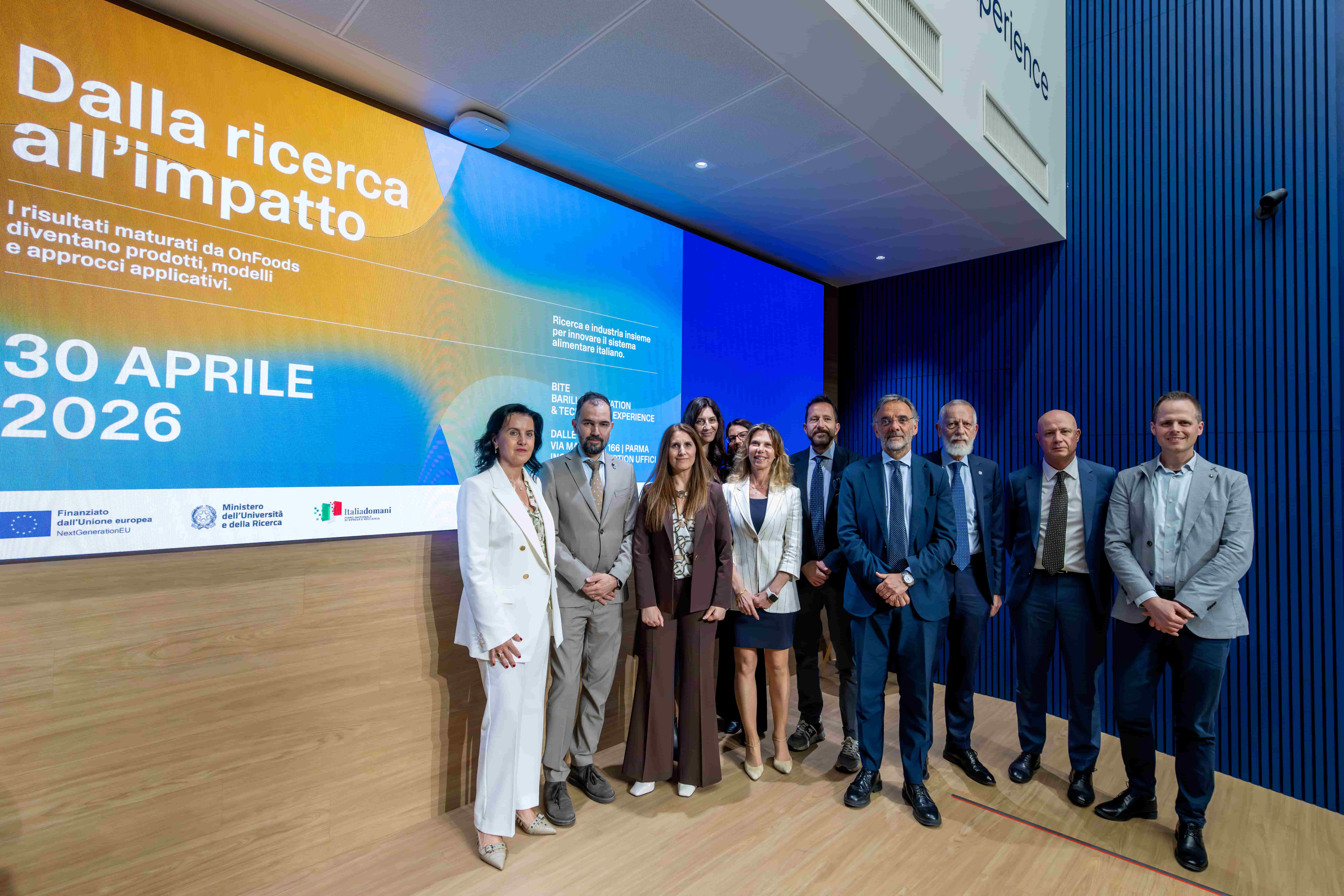
“The Emilia-Romagna Region is honoured by the body of knowledge and applications OnFoods has produced. Competitiveness is built through solid teamwork that operates at European and international scale: that's where the real game is played. Soon, the network of universities and local authorities will be called on to weigh in on the regional strategy document for the 2028–2034 programming cycle, as part of the Pact for Work, Climate, and Social Economy,” said Barbara Lori, Deputy President of the Emilia-Romagna Regional Legislative Assembly.
Many of OnFoods's results have been validated directly in real-world settings. Food-reformulation work, for instance, spanned more than ten product categories and produced measurable outcomes: lower sugar and salt levels in consumers' weekly diets, and a number of new products, one of which has already reached the market. In total, more than 130 food prototypes were developed to improve nutritional quality and sustainability, alongside safety and consumer acceptability.
“At OnFoods we worked on one specific point: bringing research and application inside the same processes. That changes the way results emerge, because they're built within real contexts of use from the start,” said Daniele Del Rio, President of the OnFoods Foundation.
That approach yielded a wide-ranging portfolio: over 100 analytical methods and smart applications for verifying food quality and safety, more than 200 solutions for sustainable distribution, and over 50 tools designed for different food-system stakeholders. To these, add the findings aimed at supporting the transition toward healthier and more sustainable models, drawn from studies on diverse population groups, including the most vulnerable, that examine the links between diet, nutritional status, and health, the acceptability of foods and dietary patterns, and the impact of personalised nutrition strategies.
Beyond industrial applications, the work also produced effects at the systems level: sustainability metrics for supply chains, decision-support tools for public and private actors, food-procurement projects, and guidelines already adopted at regional level for institutional catering.
“Scientific quality is the starting point, but on its own it isn't enough. Evidence has to be tested in real settings, keeping rigour intact while opening up to other forms of knowledge and expertise,” emphasised Patrizia Riso, coordinator of the OnFoods scientific committee.
That shift has also brought into sharper focus the way research impact itself is understood.
“In research, we talk a lot about impact, but we rarely make it visible. OnFoods forced us to follow our evidence all the way through to application. We need to be clear, though: outputs, outcomes, and impact aren't the same thing. Impact is what changes over time in behaviours, in systems, and in health, and it requires continuity well beyond a project's lifespan,” observed Hellas Cena.
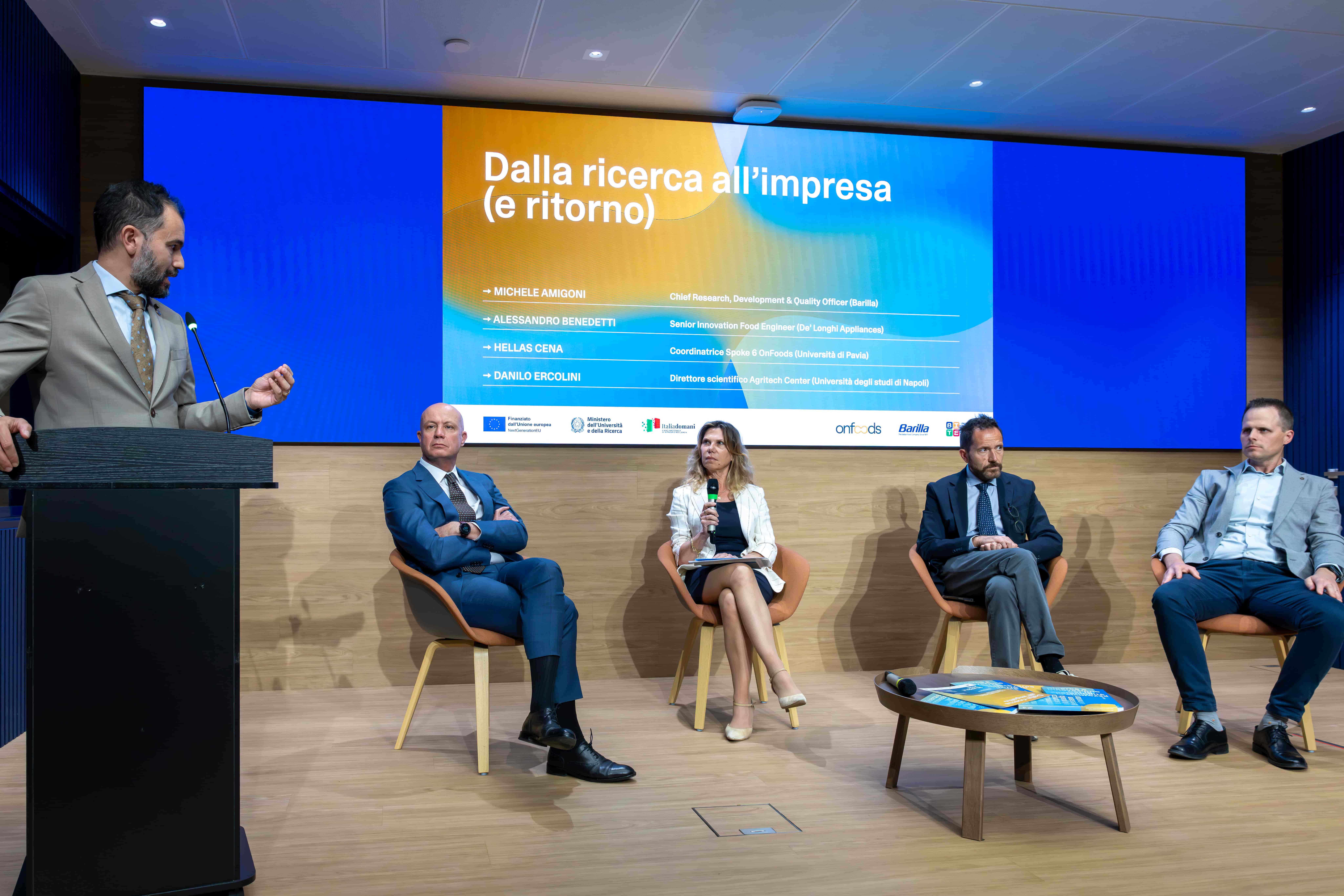
A significant share of the work centred on building skills. The mentorship programme operated as a continuous training infrastructure, bringing together scientific output, technology transfer, and communication through seminars, workshops, and co-design activities with industry.
“Research doesn't end with results. It demands skills, relationships, and the capacity to apply what's discovered. At OnFoods we worked to build those conditions, weaving together training, research, and outward engagement,” observed researcher Claudia Favari.
For companies, that meant getting involved in the earliest phases of research.
“Co-design at the lower Technology Readiness Levels is decisive: that's where needs get shared. The awareness is there now. But we mustn't lose sight of competitiveness,” said Michele Amigoni, speaking for Barilla.
From the standpoint of PNRR partnerships, the experience also revealed what makes such collaborations work. Danilo Ercolini addressed this in his dual role within OnFoods and the Agritech Center.
“What worked in the tandem between these two sibling projects? First, a clear separation of objectives, plus the fact that we collaborated with different sets of companies. That ended up making us complementary across the whole disciplinary and applied spectrum, from field to human health, as the saying goes. No major issues emerged, but there's room to improve. Things flow more smoothly when solutions come out of direct dialogue with industry; when it comes to more exploratory advances in knowledge, the process needs different timelines and approaches. That's the direction research partnerships are heading, toward greater convergence between research and industry.”
The event itself - “From Research to Impact,” hosted at BITE, the Barilla Innovation & Technology Experience - made this kind of practice visible in its very setting: a space where research, development, and production live side by side.
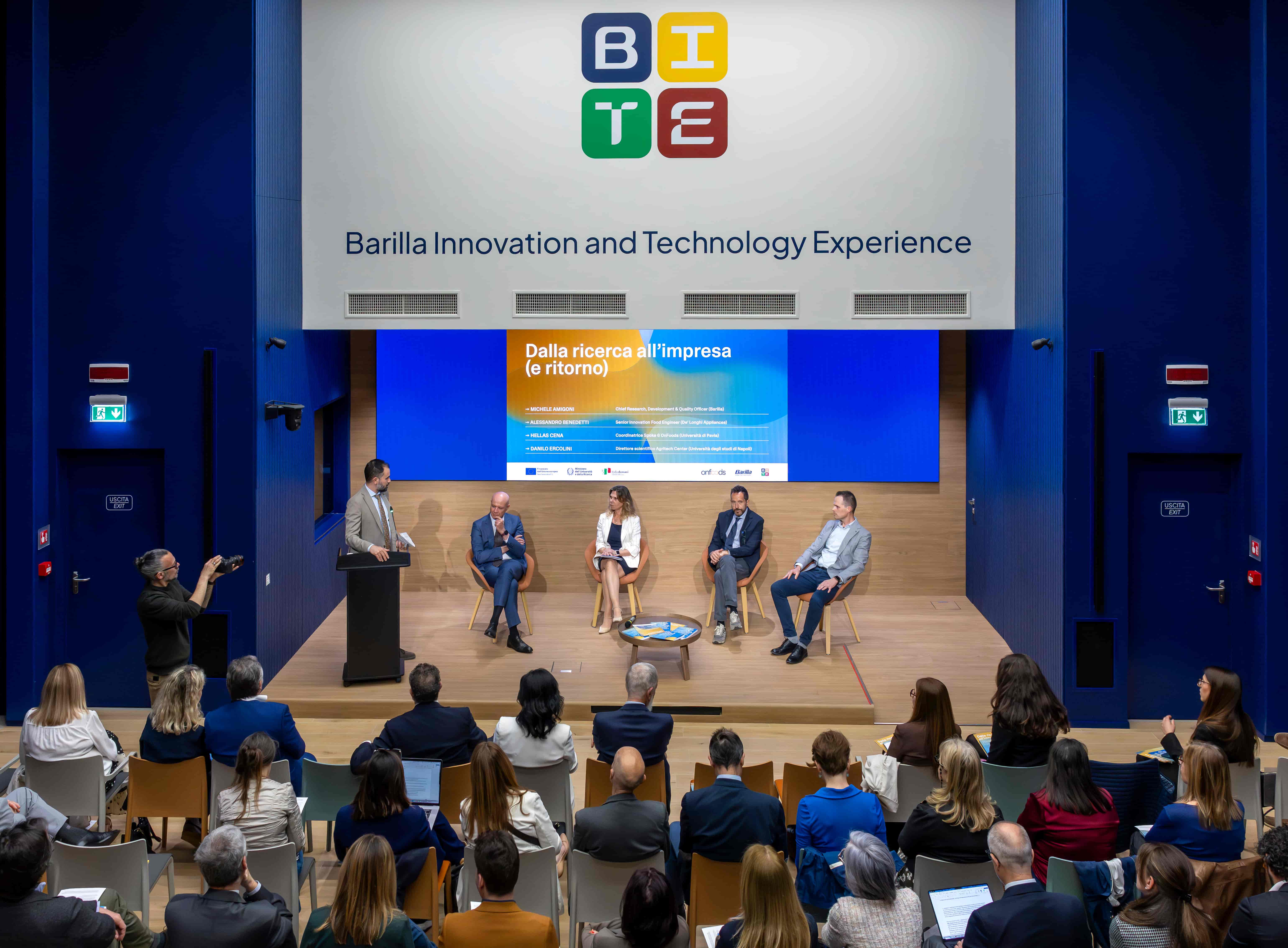
“We've made our expertise and infrastructure available to work on solutions that can be tested under real conditions. That brings research and production tangibly closer together,” the Barilla Group said.
At the institutional level, the project sits within a wider shift.
“The PNRR forced public administration to change its approach: to work by objectives, timelines, and execution capacity, even under unfamiliar conditions. It was an exercise in dialogue between administrative and scientific expertise,” said Fabrizio Cobis of Italy's Ministry of University and Research. “But this isn't the end: new instruments - like the €50 million Synergy Grant call - aim to strengthen complex projects built through public-private networks.”
The story of the OnFoods Foundation, which began in late 2022, won't end with the project's formal closing date. Plans are already taking shape to ensure long-term sustainability and to extend the impact of the many capabilities and skills brought together over the course of the project, concluded president Daniele Del Rio.
